KOSPI at 6300, But Why Can't Rates Fall? — Korean Economy Trapped in K-Shaped Growth
⚠️ This article was written as of February 27, 2026. Interest rates, exchange rates, and economic forecasts are subject to constant change.
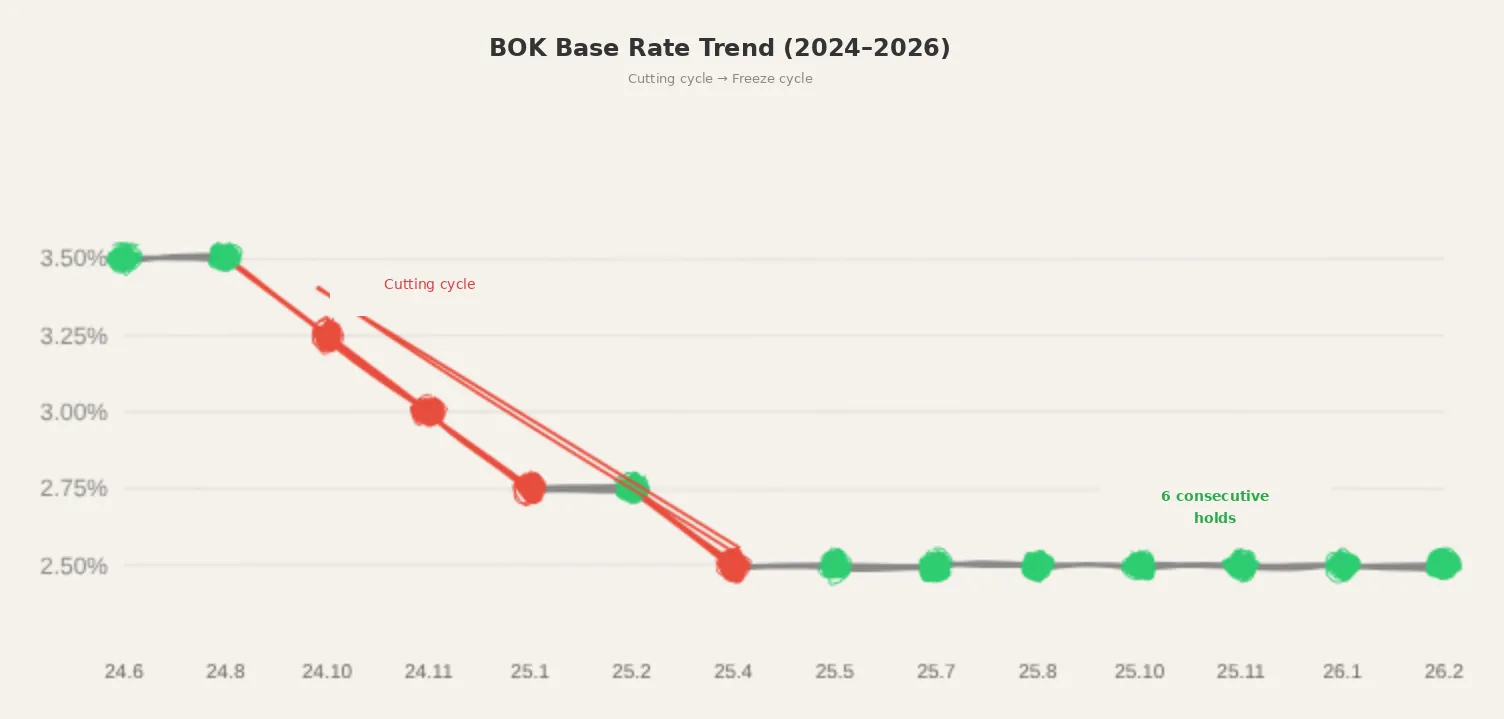
KOSPI broke through the 6300 level, surging 44% year-to-date. Yet on February 26, the Bank of Korea’s Monetary Policy Committee kept the base rate frozen at 2.50% for the sixth consecutive time. Stock markets hit all-time highs, but why can’t rates come down? We examine the structural dilemma facing the Korean economy, alongside the hidden messages in Governor 이창용’s first-ever dot plot disclosure1.
What the Dot Plot Reveals: 16 vs 4 vs 1
The biggest highlight of this monetary policy meeting was the first-ever dot plot release. Anonymous six-month rate forecasts from 21 committee votes (Governor 이창용 and 6 other members voting 3 times each) showed 16 dots clustered at 2.5%. Only 4 dots landed at 2.25%, while just 1 dot marked 2.75%2.
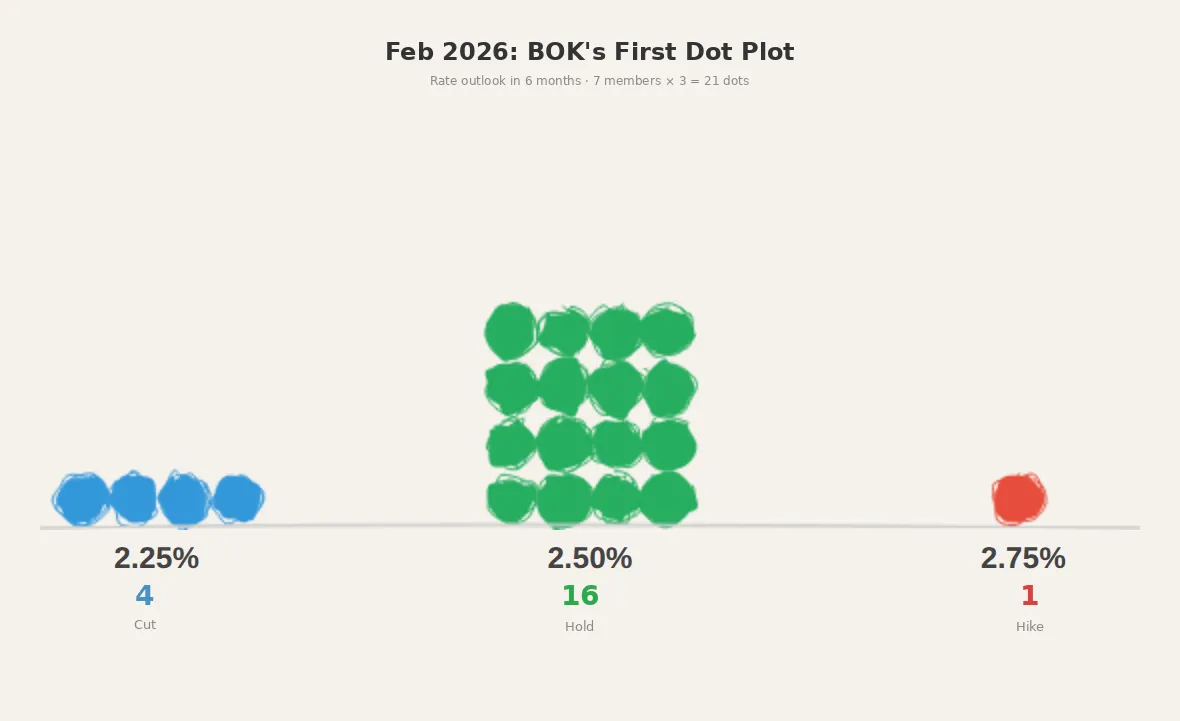
This signals that the vast majority of committee members favor maintaining current levels. More notably, one member actually suggested a 2.75% increase. While markets pressure for cuts, some members are raising concerns about potential rate hikes.
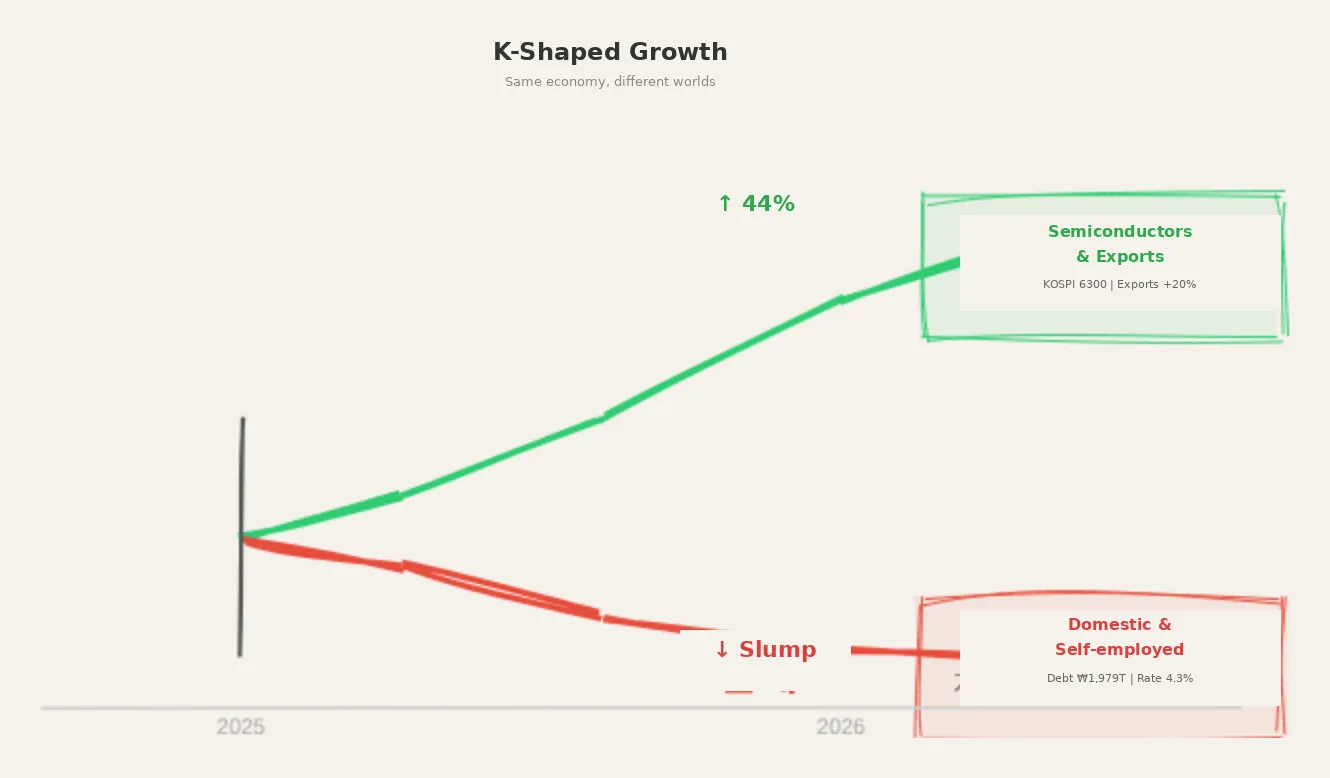
Governor 이창용 explained that “rate-cutting opinions stem from K-shaped growth”3. With semiconductors booming while domestic demand and services lag, some members are taking an accommodative stance due to growth slowdown concerns.
KOSPI 6300 vs Domestic Recession: The Reality of Polarization
Light and Shadow of the Semiconductor Super Cycle
KOSPI soared to the 6300s just two days after breaking the historic 6000 barrier for the first time on February 254. Samsung Electronics broke the $1 trillion market cap threshold, joining the global top-10 companies. January semiconductor exports reached $20.5 billion, marking significant year-over-year growth5.
However, this strength isn’t spreading across the broader economy. Bank of Korea’s upward GDP revision from 1.8% to 2.0% was attributed to “semiconductor and other export strength”6. Conversely, this implies that other sectors excluding exports remain sluggish.
Small Business Owners Still Suffering
Household debt hit a record 1,978.8 trillion won in Q4 20257. Notably, second-tier financial institution household loans increased by 4.8 trillion won, reversing from -4.6 trillion won the previous year. This suggests that ordinary people unable to borrow from primary financial institutions are being pushed toward high-rate second-tier lenders.
January mortgage rates averaged 4.29%, hitting 14-month highs8. This marks four consecutive months of increases. Jeonse loan rates also entered the 4% range. No matter how high KOSPI climbs, borrowers’ interest burdens continue mounting.
The Structural Reasons Behind 1400 Won Exchange Rates
Sandwiched Between Dollar Strength and Yen Weakness
The won-dollar exchange rate hit 1433.42 won on February 26, remaining stuck in the mid-1400s9. Governor 이창용 warned that it’s “too early to feel secure about exchange rates; volatility remains at high levels”10.
The persistence of high exchange rates is structural. 85% of macroeconomic experts forecast that “this year’s won-dollar rate will stay between 1400-1450 won”11. With shrinking trade surpluses, continued overseas investment by residents, and most importantly, a -1.25%p interest rate differential with the US, it’s difficult to expect won appreciation.
Exchange Rate Instability Creates Rate-Cut Deadlock
Exchange rate instability is a key factor making rate cuts difficult. Cutting rates would widen the Korea-US rate differential further, increasing capital outflow pressure. With US rates at 3.75%, additional Korean rate cuts carry significant burden.
Real estate markets add to the pressure. Seoul apartment prices rose 0.15% in the third week of February12. While Governor 이창용 assessed that “Seoul housing price increases are moderating”, upward trends continue. Concerns persist that rate cuts could reignite real estate markets.
Uncertainty After April
Governor 이창용’s Final Card
Governor 이창용’s term expires on April 20. The April 10 monetary policy meeting will be his last. Most experts see April freezes as likely. How monetary policy direction changes under the new governor remains uncertain.
The opinion dispersion revealed in the dot plot is also noteworthy. The 16-4-1 distribution shows committee members are divided. The four dovish members worry about K-shaped growth side effects, while the one hawkish member appears to prioritize inflation or financial stability.
Second-Half Scenarios: Cuts vs Continued Freezes
Markets are discussing possibilities of 1-2 cuts in H2 2026. However, given multiple risk factors, this seems challenging.
Cut conditions are clear: ▲Exchange rate stabilization ▲Real estate market cooling ▲Economic slowdown signals must all align. Conversely, if any deteriorate, continued freezes become inevitable.
US economic conditions are particularly variable. If the US stops additional rate cuts or pivots to increases, Korea’s rate cut conditions become even more difficult.
What Individual Investors and Borrowers Need to Know
Borrowers: Prepare for Extended High Rates
Mortgage rates climbed to 4.29%, with further February increases expected13. With base rate cuts unlikely in the near term, variable rate borrowers should prepare for extended high rates.
Particularly, increasing second-tier financial institution loans signal danger. As borrowers get pushed from primary to high-rate institutions, default risks are rising. Loan delinquency rates also show upward trends, requiring caution.
Investors: Finding Sectors Beyond Semiconductors
KOSPI’s 6300 breakthrough was semiconductor-driven. However, in K-shaped growth structures, semiconductor strength duration remains uncertain. Securities firms project KOSPI targets up to 790014, but this assumes continued semiconductor super cycles.
With delayed domestic recovery, semiconductor-dependent portfolios carry risks. Reduced rate cut expectations could actually hurt financials and real estate-related stocks.
Conclusion: Structural Reform Must Come First
The disconnect between KOSPI 6300 and rate freezes starkly reveals Korean economy’s structural problems. Semiconductors alone cannot lift the entire economy. Without escaping K-shaped polarization, stock market progress will inevitably hit limits.
Governor 이창용’s mention that “ultimately, resolving capital region concentration is necessary” reflects this context15. Simple monetary policy cannot solve structural imbalances. Structural reforms reducing regional, sectoral, and class polarization must take priority.
Six consecutive rate freezes were perhaps inevitable choices. However, escaping this dilemma requires fundamental economic structural reform. Only then can KOSPI gains spread throughout the broader economy.
Footnotes
-
서울신문, “한은, 기준금리 2.5% 6연속 동결…올해 성장률 전망 2.0%로 상향”, 2026.02.26, https://www.seoul.co.kr/news/economy/finance/2026/02/26/20260226500054 ↩
-
이투데이, “한은 첫 점도표 살펴보니…6개월 후 기준금리 전망 2.5%에 쏠려”, 2026.02.26, https://www.etoday.co.kr/news/view/2559861 ↩
-
이투데이, “이창용 “점도표는 익명 작성⋯금리하향 의견 ‘K자형 성장’서 기인"", 2026.02.26, https://www.etoday.co.kr/news/view/2559939 ↩
-
서울신문, “끝 모를 코스피, 6300도 ‘훌쩍’… 삼성전자 시총 첫 1조 달러”, 2026.02.27, https://www.seoul.co.kr/news/economy/securities/2026/02/27/20260227030005 ↩
-
중앙일보, “‘6000피’ 랠리 속 제자리 실물경기…반도체 독주에 “K자형 간극 커진다"", 2026.02.25, https://www.joongang.co.kr/article/25407304 ↩
-
블록미디어, “한은, 올해 성장률 전망 2.0%로 상향…”반도체 경기 호조 반영"", 2026.02.26, https://www.blockmedia.co.kr/archives/1052060 ↩
-
매일경제, “사상 최대 가계부채 1978조원…”빚투·영끌” 여파”, 2026.02.21, https://www.mk.co.kr/news/economy/11967339 ↩
-
이투데이, “1월 은행 주담대 평균금리 4.29% 넉 달째 상승⋯고정형 주담대 급감”, 2026.02.27, https://www.etoday.co.kr/news/view/2560462 ↩
-
Trading Economics, “South Korean Won”, https://ko.tradingeconomics.com/south-korea/currency ↩
-
서울파이낸스, “이창용 “서울 집값 오름세 진정⋯환율 안심하기 일러"", 2026.02.26, https://www.seoulfn.com/news/articleView.html?idxno=622239 ↩
-
조선비즈, ""고환율이 뉴노멀”…전문가 85% “올해 원·달러 1400–1450원"", 2026.01.01, https://biz.chosun.com/policy/policy_sub/2026/01/01/RWJZVZWZGRABJERXPIRK27HYOA/ ↩
-
서울파이낸스, “이창용 “서울 집값 오름세 진정⋯궁극적으로 수도권 집중 해소 필요"", 2026.02.26, https://www.seoulfn.com/news/articleView.html?idxno=622239 ↩
-
파이낸셜뉴스, “또 오른 주담대금리…1월 4.29% ‘14개월 만에 최고’”, 2026.02.27, https://www.fnnews.com/news/202602270828200270 ↩
-
스마트비즈, “코스피, 사상 첫 6000 돌파···증권가 “7900까지 갈수도"", 2026.02.26, https://www.smartbizn.com/news/articleView.html?idxno=136965 ↩
-
서울파이낸스, “이창용 “서울 집값 오름세 진정⋯궁극적으로 수도권 집중 해소 필요"", 2026.02.26, https://www.seoulfn.com/news/articleView.html?idxno=622239 ↩